
Home / Blog / SEO and Web Design: 9 Ways They Win in Pittsburgh
SEO basicsSEO and Web Design: 9 Ways They Win in Pittsburgh
SEO and web design only pay off together. See how structure, speed and content turn Pittsburgh searchers into callers, with a build order you can follow.

- SEO brings the right people to your site, and design and writing turn them into calls.
- Google's Web Vitals give clear speed targets, so design choices affect search performance.
- Plan keywords and page structure before design starts, or you pay to rebuild later.
- Pittsburgh customers search by service and neighborhood, so your pages should too.
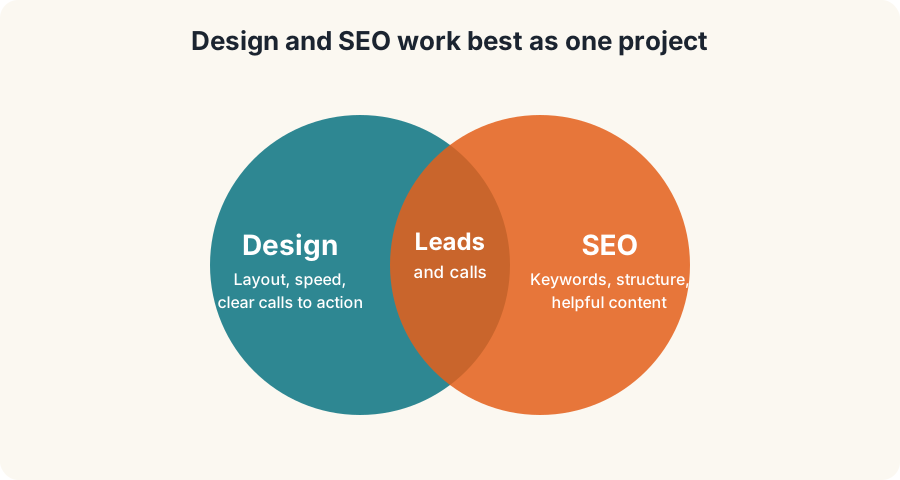
SEO and web design are two halves of one job. SEO gets the right people to your website. Web design and writing turn those people into calls, bookings and sales. If you do only one, the other half stays undone, and you pay for the gap every month.
This guide is for owners who are about to build or redo a site. We use Pittsburgh examples because we serve that market closely, and because Pittsburgh small business owners often search and shop neighborhood by neighborhood.
Why SEO and web design fail apart
Look at what goes wrong when they are split.
SEO without design
- Visitors arrive from search
- The page is slow or confusing
- They leave without calling
Design without SEO
- The site looks great
- Nobody searches their way to it
- You rely on referrals only
A beautiful site with no search plan is a billboard in a field. A well-optimized site that is slow, cluttered or hard to use is a shop with a locked door.
SEO and web design work best when one team plans both from the start. That is why we build the page list, the headings and the layout in the same conversation.
What SEO decides before web design starts
Search research decides the shape of your site. It is cheaper to learn this on paper than after launch.
Before anyone opens a design tool, SEO answers four questions.
- Which searches do your customers use for each service?
- Which of those deserve their own page?
- Which neighborhoods and suburbs do you want to be found for?
- What questions do customers ask before they buy?
The answers give you a page list. A roofer might need separate pages for repair, replacement and storm damage. A dentist might need pages for each treatment and a first visit page. This is the base for good SEO and web design: a site map built from real searches, not from a guess.
Pittsburgh SEO and web design start with how people search
Pittsburgh customers rarely search for a generic service. They add a place. They search with a neighborhood in mind, such as Squirrel Hill, Lawrenceville, Shadyside or the South Side, or with a suburb in mind, such as Mt. Lebanon, Bethel Park, Monroeville or Cranberry Township.
That has a design consequence. Your site should say clearly where you work, and it should not hide that in a footer. A visitor from Bethel Park should see the South Hills named on the page that matters.
It also has an SEO consequence. A business that serves several areas usually needs separate, useful pages for the places it truly serves, each with real details. Copying one page and swapping the town name does not help anyone. Our Pittsburgh SEO services work starts with this map.
How SEO and web design work together, step by step
Here is the order we follow.
- Research. Find the searches your customers use and the questions they ask.
- Structure. Give each topic its own page with a clean address and clear headings.
- Design. Make each page fast, readable on a phone and clear about the next step.
- Write. Put the answer first, then the details, proof and a call to action.
- Measure. Track visits, calls and forms, then improve what the data shows.
Skip one step of SEO and web design and the rest suffer. Design without research guesses at the menu. Research without design becomes a spreadsheet nobody uses.
What design decides after the click
Once someone lands, design decides what happens in the first few seconds. Visitors scan. They want to know three things: did I find the right business, can they help me, and what do I do next.
Here is what the design half of SEO and web design should deliver. A page that serves a search well usually has:
- A headline that matches what the visitor searched.
- A phone number at the top that taps to call on a mobile phone.
- One or two lines that say who you help and where.
- Real photos of your work and team, not generic stock.
- Proof such as reviews and credentials, only if they are real.
- One clear button, repeated down the page.
Our guide to a conversion focused website goes deeper on layout, and the list of website mistakes that lose leads shows the common traps.
Speed is where SEO and web design meet
Speed is a design decision with a search consequence. Large images, heavy scripts and crowded layouts slow a page down.
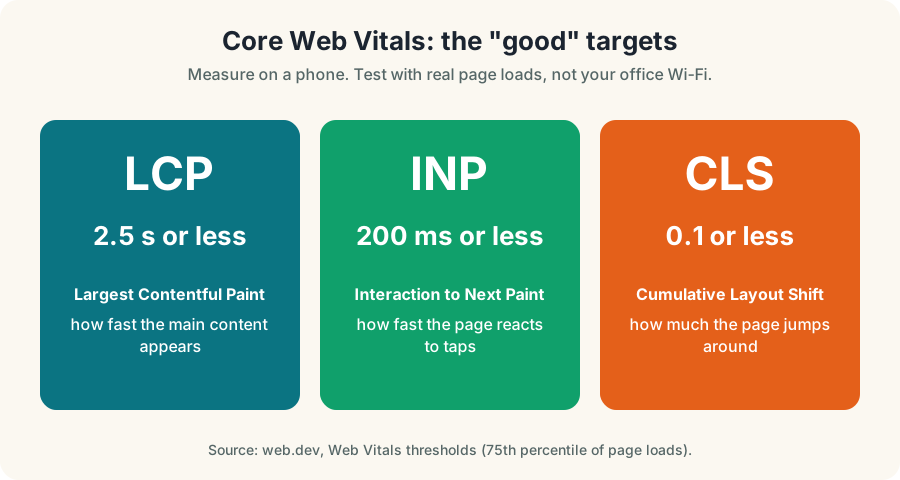
web.dev publishes "good" thresholds for Core Web Vitals. Largest Contentful Paint, which measures how fast the main content appears, should be 2.5 seconds or less. Interaction to Next Paint, which measures responsiveness, should be 200 milliseconds or less. Cumulative Layout Shift, which measures unexpected movement, should be 0.1 or less.
These are targets for the page experience, and they are a good brief for a designer. Ask your team how the design will meet them, and how they will check it on a real phone.
Mobile first, because your customers are
Many Pittsburgh searches happen on a phone. A person in Oakland between classes, a driver in Monroeville with a flat tire and a homeowner in Mt. Lebanon with a leak all want an answer fast.
So design the phone layout first. Keep text readable without zooming, keep buttons big enough for a thumb and keep forms short. A desktop-only mindset hurts both usability and search performance, because the page that works on a phone is the page most customers see.
A table of pages and what each one does
Here is how a typical local service site splits the work between SEO and web design. Adapt it to your business.
| Page type | SEO job | Design job |
|---|---|---|
| Home page | Introduce who you are and where you work | Send visitors to the right service quickly |
| Service page | Match one search, such as a specific repair | Answer, show proof, offer one next step |
| Area page | Show you truly serve a place | Give local details and a clear contact option |
| About page | Build trust and show real people | Photos, story, credentials that are real |
| Blog or guide | Answer a question in depth | Easy to read, links to the next step |
| Contact page | Confirm name, address and phone | Short form, tap-to-call, map |
This is the backbone of our Pittsburgh web design and development work. Each page has one SEO job and one design job.
Content where SEO and web design shake hands
Good content is where the two meet. Lead with the answer, then add detail. Use short paragraphs, descriptive headings and lists where steps matter.
Google Search Central says there are no special optimizations or new files needed for its AI features beyond the usual Search fundamentals. Pages must be indexed and eligible to show with a snippet, and structured data must match the visible text. That means the clear, honest, well-structured page you build for people is also the page to build for search.
Pew Research Center (July 2025) found users clicked a traditional result about 8% of the time when an AI summary appeared, compared with about 15% when it did not. When fewer visitors click, each visit matters more, so the page has to earn the call. We explain how to watch for this in how to track AEO.
A hypothetical redesign gone wrong
This is an illustration, not a client result.
Suppose a Pittsburgh contractor hires a designer who delivers a beautiful new site. It has a big video, a few sentences of text and one page called Services. The old site had separate pages for each job, and some of them ranked.
After launch the old addresses are gone, the new page has little to say, and the calls drop. The owner blames SEO. The real problem is that nobody planned SEO and web design together.
Done right, with SEO and web design planned together, the team would list the old pages that bring traffic, keep their content and addresses or redirect them properly, and design the new layout around them.
The SEO and web design plan before any redesign
If you are about to redesign, use this checklist first.
- Write down the ten searches you most want to be found for.
- List the pages that already bring visitors and calls, and protect them.
- Map each search to a page, new or existing.
- Decide which neighborhoods and suburbs you serve for real.
- Set speed and mobile targets using the Web Vitals thresholds.
- Plan how you will track calls, forms and bookings.
- Only then start the design.
For a deeper rebuild, our web design company in Ohio page explains how we run projects across our markets.
Site structure, menus and internal links
Structure is the part of SEO and web design that visitors never notice and search engines always do. A clean menu, short readable addresses and sensible links between pages help both groups find what they need.
Keep the main menu short. Put your core services in it, and use clear words, not clever ones. Name the page "Roof Repair", not "Our Solutions".
Link related pages to each other with descriptive text. A roof repair page can point to storm damage and to your contact page. Each link tells the visitor and the search engine how your pages relate. Use one main heading per page, then subheadings in order, so a person scanning on a phone can follow the page.
Pittsburgh Google Ads, SEO and the same landing pages
If you also run Pittsburgh Google Ads, the pages you build for SEO and web design do double duty. A page that matches a search, loads fast and makes the next step obvious converts paid clicks and organic visitors alike.
That is a strong reason to build the page once, properly. It also means design changes pay off twice. Our Pittsburgh Google Ads management team uses the same pages we build for search, and we compare the leads from each source. Our guide to local SEO vs Google Ads explains when to lean on each.
Trust signals that help people and search
Trust is where design and SEO overlap again. Visitors look for signs that a business is real before they call. Search engines look for signs of reliability too.
Real signs of trust include:
- Your business name, address and phone number, the same everywhere.
- Photos of your actual work and team.
- Reviews from real customers, shown honestly.
- Clear descriptions of what you do and who you serve.
- A privacy page and a working contact form.
Do not invent awards, numbers or testimonials. They hurt trust when found out, and they can break platform rules. For a Pittsburgh small business, a few honest details about your neighborhood, your team and your process beat a wall of vague claims.
Planning for AI search from day one
More customers now ask assistants and see AI summaries before they click anything. You do not need a separate site for that. Google Search Central says there are no additional requirements for AI Overviews and AI Mode beyond the usual Search fundamentals.
What helps is a site that is easy to read, clear about facts and consistent. Put hours, services and areas in real text, not only in images. Keep them identical on your site and your Google Business Profile. Our Pittsburgh AI search optimization service builds on the same pages we plan for SEO and web design.
Questions to ask your designer and your SEO
Before you sign anything, ask both sides the same questions. If the answers do not match, you have found the gap.
- Which pages will the new site have, and which searches does each one target?
- What happens to my current pages and addresses? Will they be redirected?
- How will the site meet the Web Vitals thresholds on a real phone?
- Who writes the page copy, and who checks that it is accurate?
- How will you track calls and forms after launch?
- What will you do in the first 90 days after the site goes live?
A team that treats SEO and web design as one project will answer these easily. A team that points at the other side of the table is telling you something. Good Pittsburgh web design should come with a search plan, and good Pittsburgh SEO should come with a say in the layout.
Measuring whether SEO and web design are working
You need two kinds of numbers. Search numbers tell you whether people find you. Action numbers tell you whether they act.
- Search Console shows impressions, clicks and the queries that bring people in.
- Analytics shows which pages people visit and where they leave.
- Calls, forms and bookings show whether the page did its job.
- A simple question on the phone, "How did you find us?", fills the gaps.
If search numbers rise and calls do not, look at design and copy. If calls are fine but searches are flat, look at SEO. This is the quickest way to see which half of SEO and web design needs work. Our FREE AI Visibility Test gives you a quick baseline of how you show up in AI answers.
Mistakes we see most often
- Designing first, planning later. The pages get built around looks, then rebuilt around searches.
- Hiding the phone number. A visitor who cannot call fast leaves.
- Heavy pages. Huge images and plug-ins slow the site and lose people.
- One page for everything. A single services page cannot answer ten different searches.
- No tracking. Without data, every decision is a guess.
- Expecting overnight results. Google says crawling and indexing can take several days to several months.
Who should do what
Some owners can handle parts of this themselves. Writing honest service descriptions and collecting reviews are good DIY tasks. Technical speed work, site structure and tracking are usually worth handing to a team.
The key is that one person owns the whole picture. When a designer, a writer and an SEO each work alone, the pieces rarely fit. When one team plans SEO and web design together, the site launches ready to be found and ready to convert.
Our Pittsburgh digital marketing team handles the build, the search work and the reporting. If you are weighing options, contact us with your current site and the ten searches you care about, and we will tell you honestly what to keep, fix or rebuild.
Questions, answered
Is SEO or web design more important?
They do different jobs. SEO gets people to the page. Design and content get them to act. If one is missing, the other underperforms.
Should I build the site before doing SEO?
Plan SEO first. Your target searches decide your pages, headings and menu, so doing the research before design avoids rebuilding later.
Does web design affect SEO rankings?
Yes, indirectly and directly. Page speed, mobile layout and clear structure are part of how Google evaluates pages, and a confusing layout loses visitors who would have called.
What are good page speed targets?
web.dev lists the Web Vitals good thresholds as Largest Contentful Paint of 2.5 seconds or less, Interaction to Next Paint of 200 milliseconds or less, and Cumulative Layout Shift of 0.1 or less.
Do I need special markup for AI search?
Google Search Central says there are no additional requirements or special optimizations for AI Overviews and AI Mode beyond the usual Search fundamentals. Pages must be indexed and snippet-eligible.
Ask Eighty. He answers in plain English, any time.
Want this done for your business?
Book a FREE 20-minute growth call. We will tell you where you stand and what to fix first.
Get my FREE growth plan SEO basicsHow Long Does SEO Take? What the Data Says