
Home / Blog / Small Business Marketing Budget: Pittsburgh Guide
BusinessSmall Business Marketing Budget: Pittsburgh Guide
Set a small business marketing budget from your cash flow, track spend to real customers and avoid cash traps. A practical Pittsburgh guide.

- Set the marketing budget from your cash flow and what a customer is worth.
- Fund foundations first, then steady SEO, then capped ads, and keep a cash reserve.
- Track every channel to calls, customers and revenue each month.
- Never cut your foundation in one slow month, because leads dry up later.
A Pittsburgh small business should set its small business marketing budget from its cash flow, track every dollar to calls and customers, and review results monthly. Marketing that is not tied to money in and money out is a guess. This guide covers a simple way to decide what to spend, how to track it and how to avoid the cash-flow squeeze that sinks good businesses.
We are a marketing and business consulting firm, not accountants or financial advisors. Use this as a practical framework and check tax and legal questions with a qualified professional.
Start with cash flow, not the marketing plan
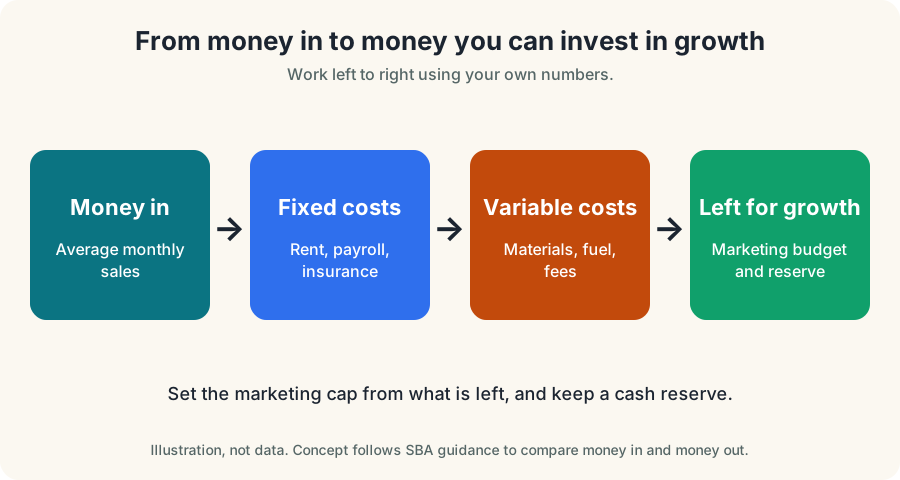
Cash flow is the movement of money in and out of the business. Profit on paper does not pay rent or payroll in a slow month. The U.S. Small Business Administration advises owners to compare money in with money out, categorize expenses and keep a business bank account. Marketing belongs inside that picture, not outside it.
- List monthly money in. Average sales over the past six to twelve months, noting slow and busy seasons.
- List fixed costs. Rent, insurance, software, vehicle, payroll and loan payments.
- List variable costs. Materials, fuel, subcontractors and card fees.
- Find what is left. That remainder is what you can responsibly consider for growth.
Decide what marketing is worth to you
Before you spend, work out what one new customer is worth. Use your own numbers.
What to calculate
- Average sale value
- How many times a customer buys
- Gross margin on that sale
- Close rate on inquiries
What it tells you
- How much a customer is worth
- How much you can pay to get one
- Whether a channel is profitable
- When to stop a campaign
For example, a Pittsburgh roofing company that earns a good margin on a larger job can afford a higher cost per lead than a cafe selling a coffee. The point is that you set the limit from your own numbers, not from what a competitor spends.
A simple small business marketing budget framework
- Foundations first. A fast, clear website, an accurate Google Business Profile and call tracking. These keep working long after you pay for them.
- Steady growth. Local SEO content and reviews, which build over months.
- Fast demand. Google Ads or paid social for urgent jobs, with a hard monthly cap.
- Reserve. Keep a cushion so a slow month does not force you to cut marketing at the worst time.
The SBA suggests including a complete breakdown of the costs of your marketing plan and tracking those costs once the plan is running. Do both.
Tracking: where marketing money turns into numbers
You cannot manage what you cannot see. Set up these basics.
- Call tracking. Use a tracking number on your website and Google Business Profile, or ask every caller how they found you.
- Forms and bookings. Record each one with its source.
- A one-page sheet. Each month, list spend by channel, leads, customers won and revenue.
- Cost per lead and cost per customer. Divide spend by leads and by customers won.
Read our guides on tracking AEO and Local SEO versus Google Ads for the marketing side of this tracking.
Cash-flow traps that hit small businesses
- Paying for ads without a cap. Set a monthly limit and review weekly.
- Slow-paying customers. Invoice quickly and follow up.
- Cutting marketing after a bad month. Leads dry up two months later. Keep the foundation running.
- Mixing personal and business money. Use a separate account so your numbers are clear.
- No reserve. One slow season can empty the account.
A Pittsburgh example, in numbers you can adapt
This is an illustrative example, not a client result. Suppose a Pittsburgh service business earns an average job value of 1,200 dollars with a 40 percent gross margin, which is 480 dollars of margin. If about one in four quality leads becomes a customer, the business can afford to pay roughly up to 120 dollars per lead before it earns nothing on that job, and should aim well below that. If a campaign costs 60 dollars per lead, the business keeps margin. If it costs 150 dollars per lead, it loses money on each job. Replace every number with your own.
Seasonal cash flow in Western Pennsylvania
Many Pittsburgh businesses see seasonal swings, such as roofing and landscaping in warmer months and heating or snow services in winter. Plan marketing spend and cash reserves against your own seasonal history. Build content and local pages ahead of your busy season, because organic results take time. Google says crawling and indexing can take anywhere from several days to several months.
The monthly money meeting
Once a month, spend an hour on this routine.
- Review cash. What came in, what went out, what is left.
- Review marketing. Spend, leads, customers and revenue by channel.
- Keep, fix or stop. Decide each channel.
- Set next month's cap. Write it down.
Questions Pittsburgh owners ask
How much should a small business spend on marketing?
There is no single correct percentage that applies to every business. Set the budget from your margins, cash flow and what a customer is worth, then adjust with results.
Should I pay for ads or SEO first?
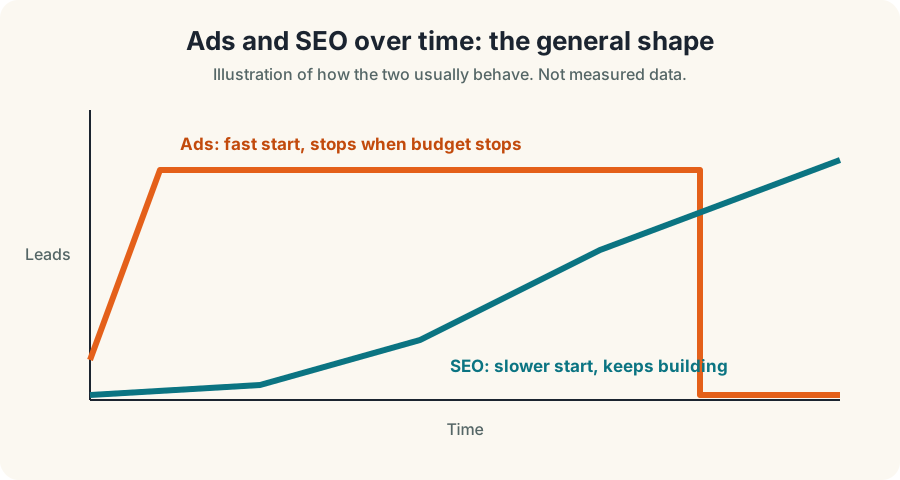
If you need calls soon, ads can start faster. SEO takes longer but keeps working. Many businesses use both with a hard cap on ads.
How long before marketing pays off?
It depends on the channel and your market. Ads can bring leads quickly. SEO usually takes months.
Next steps
If you want help turning marketing spend into tracked leads, see our Pittsburgh business consulting and Pittsburgh digital marketing services.
Where the FREE tools fit
Use our marketing budget calculator to test scenarios with your own numbers, and our missed call calculator to see what unanswered calls may cost you. Both are FREE and use only the numbers you enter. They are estimates, not predictions.
How Pittsburgh owners can connect marketing to cash flow
A Pittsburgh contractor, restaurant, clinic or shop has different cash patterns, but the discipline is the same. Write down the months when money is tight, the months when you are busiest and the months when leads slow down. Schedule marketing work for the quiet months so it is ready for the busy ones, and cap paid spend in any month where cash is thin.
| Question to ask | Where to find the answer |
|---|---|
| What do we earn per job or sale? | Your invoices and costs |
| Which months are slow? | Your last 12 months of bank deposits |
| Where do new customers come from? | Call tracking, forms and asking customers |
| What does one lead cost us? | Spend divided by leads |
For help setting this up, see our Pittsburgh SEO services and Pittsburgh Google Ads management pages.
Warning signs your marketing spend is not working
- Leads, but no customers. Your offer or follow-up may be the problem, not the ad.
- Rising cost with no change in sales. Pause and review.
- No one knows the source. You cannot manage what you cannot see.
- Spend is growing faster than cash. Cap it.
Your small business marketing budget should come from cash flow, be tracked monthly and be reviewed with real numbers. A small business marketing budget is a decision you revisit, not a number you set once.
Worked examples by industry
The pattern is the same everywhere, but the details change by business. These are illustrative examples of how to apply budgeting and tracking in common local industries. Replace the details with your own real facts.
A roofing or home services company
Customers ask: "How much does a roof replacement cost in Youngstown?", "How long does it take?" and "Do I need a permit?" A strong page opens with a plain answer, explains what changes the price (size, pitch, materials, tear-off layers), shows the steps in order and says what a written estimate includes. It names the service area, shows real project photos and lists the company's license and insurance details only if they are real and current.
A dental or medical practice
Patients ask: "Do you take my insurance?", "What happens at a first visit?" and "Is there an emergency appointment?" Pages should answer plainly, avoid promises about outcomes and be reviewed by the practice for accuracy. Health claims need extra care, so state only what the practice can stand behind.
A restaurant or cafe
Guests ask: "Do you have gluten-free options?", "Is there parking?" and "Can you host 20 people?" Put hours, menu, dietary notes, parking and private-event details in plain text, not only in images or PDFs. Keep them identical on the website and Google Business Profile.
A law, accounting or consulting firm
Clients ask: "What does a consultation cost?" and "What should I bring?" Explain the process, who the service is for and who it is not for. Avoid guarantees. Published expertise should be written by the real person who does the work, with a real bio.
An ecommerce or retail shop
Shoppers ask: "Which size should I choose?" and "Can I return this?" Product pages that answer those questions, with consistent product data, give search engines and assistants something dependable to use.
A step-by-step rewrite you can copy
Take one page and do this in order.
- Write the question the page should answer, in the words a customer would use.
- Write a two-sentence answer and put it at the top.
- Add the details underneath: steps, costs, timelines, requirements.
- Add proof. Real photos, real reviews, real credentials and real examples.
- Add a short FAQ of questions people actually ask, with direct answers.
- Check the facts. Every number, name, hour and price must be true today.
- Add a next step. A call button, a form or a booking link.
Common questions people ask next
Is this just SEO with a new name?
Mostly it builds on the same foundation. Clear, useful, accurate pages on a technically healthy site are what both depend on. The difference is emphasis: AEO focuses on direct answers, clear facts, trust and being easy to quote.
Do I need a special file or markup?
Google says there are no additional requirements or special optimizations for its AI features beyond being indexed and eligible to show with a snippet. Structured data is still worth using where it fits, as long as it matches what visitors can see on the page.
How long until I see results?
There is no fixed timeline. Google says crawling and indexing can take anywhere from several days to several months, and results depend on competition and the quality of your pages. Plan on months, not days, and measure monthly.
Can I pay to be recommended?
No reputable method guarantees a mention in an AI answer, and Google says you cannot pay to improve your local ranking. Be suspicious of anyone who promises guaranteed placement.
Glossary
Terms
- AEO: Answer Engine Optimization, making content easy to use as an answer.
- AI Overview: an AI-generated summary shown in Google results.
- Snippet: the text excerpt shown for a page in results.
- Crawler: software that visits pages to read them.
More terms
- Structured data: code that labels facts on a page for machines.
- Citation: a source an assistant links or names in an answer.
- Prompt: the question a person types or says to an assistant.
- Entity: a clearly identified thing, such as your business.
A 90-day plan
- Days 1 to 30: foundation. Confirm your site is indexed, crawlers are allowed, your Google Business Profile is complete and your facts match everywhere.
- Days 31 to 60: content. Rewrite your five most important pages answer-first and add honest FAQs.
- Days 61 to 90: proof and measurement. Collect real reviews, add case examples you have permission to share and start a monthly prompt-testing sheet.
Honest limits
No one controls what an AI assistant says. Answers change, sources change and platforms change their rules. What you can control is the quality, clarity and accuracy of what you publish, and how easy it is for customers and machines to trust it. That is a good investment even if the technology shifts, because the same pages serve people who find you in any way.
Questions, answered
How much should a small business spend on marketing?
There is no single percentage that fits every business. Base it on your margins, cash flow and customer value, then adjust with tracked results.
How do I know if marketing is paying off?
Track spend, leads, customers won and revenue by channel each month, and calculate cost per lead and cost per customer.
Should I cut marketing in a slow month?
Be careful. Cutting foundational marketing can reduce leads a few months later. Cut the weakest channel with data, not everything.
Why separate business and personal money?
A separate business account keeps your numbers clear. The SBA notes you will need a business bank account to run and track the business.
Ask Eighty. He answers in plain English, any time.
Want this done for your business?
Book a FREE 20-minute growth call. We will tell you where you stand and what to fix first.
Get my FREE growth plan AI searchAEO Content: What It Looks Like, With Examples
 AI searchAEO for Ecommerce: Get Your Products Recommended
 AI searchAEO Services: What They Include and What to Avoid