
Home / Blog / AEO for Ecommerce: Get Your Products Recommended
AI searchAEO for Ecommerce: Get Your Products Recommended
AEO for ecommerce means product, category and policy pages that answer shoppers' questions with accurate data. Here is the plan, step by step.

- Product pages should open with what the product is and who it suits.
- Keep price, stock and shipping identical everywhere from one source of truth.
- Write honest comparison guides, shipping and returns pages in plain language.
- Reviews must be real and any markup must match visible text.
AEO for ecommerce means making every product, category and policy page answer the questions shoppers ask before they buy, with accurate, consistent product facts that search engines and AI assistants can trust. Shoppers now ask assistants questions such as "which blender is best for smoothies" or "does this brand ship to Ohio", so the stores that explain clearly, show proof and keep data accurate are the easiest to recommend.
This guide covers product pages, category pages, policy pages, reviews, product data and what to measure. It also covers local stores that sell online. If you are new to the term, start with what AEO is.
Why AEO for ecommerce is different
Ecommerce questions are specific and comparative. Shoppers want to know what a product is for, what size or type to choose, how it compares, how long shipping takes and what happens if it does not work. Product pages that only list a name and a price leave all of those unanswered, and a competitor's richer page gets used instead.
There is also a data problem. Prices, stock and shipping change often. If your website says one thing and a marketplace listing or feed says another, trust drops. Accuracy is the foundation of ecommerce AEO.
Product pages: answer the buying questions
- Open with what it is and who it is for. One clear sentence before the sales language.
- List the facts shoppers compare. Size, materials, capacity, compatibility, care and what is in the box.
- Answer the common questions on the page. Fit, use, cleaning, warranty and shipping.
- Show real photos and real reviews. Use your own photos where you can.
- Be honest about limits. Say who the product is not for. It builds trust.
- Make the next step obvious. Add to cart, plus a way to ask a question.
An example
Weak: "Our premium candle brings luxury to your home."
Better: "This 8 oz soy candle burns for about 40 hours when trimmed and burned in short sessions, and comes in three scents. It suits small rooms such as a bedroom or bathroom. Here is how to burn it safely and what each scent smells like."
If a number such as burn time comes from your own testing or supplier, say so. Never copy a claim you cannot back up.
Category pages: help people choose
A category page that only shows a grid of products is thin. Add a short intro that explains how to choose, a simple comparison of the main options and links to buying guides. For example, a page for "women's running shoes" can explain terrain, cushioning and fit, then point to the right product types. This is also a natural place to target the questions shoppers type.
Comparison and buying guides
Assistants are often asked "which should I choose" questions. Publish honest comparisons between your own products, and between product types. Say when a cheaper option is enough. Pages that help people decide are more likely to be cited than pages that push.
Helpful guide
- Explains who each option suits
- Admits trade-offs
- Links to the right products
- Updated when products change
Hard sell
- Every option is "the best"
- No trade-offs mentioned
- No comparison data
- Never updated
Policy and help pages matter more than you think
Shipping, returns, warranty, sizing and contact pages answer high-intent questions such as "can I return this" and "how long does delivery take". Write them in plain language, put the answer first and keep them current. Link to them from product pages. A clear returns page reduces hesitation for customers, and it gives assistants a reliable source for your policy.
Reviews and proof
Real reviews help shoppers and are part of how businesses earn trust. Collect them after delivery, reply to them and display them honestly. Do not write or buy reviews. If you use review markup, it must reflect real reviews that visitors can see on the page. Google says structured data should match the visible text, and it also states there is no special structured data needed for its AI features.
Product data: keep one source of truth
- Pick one master record for each product: name, description, price, stock, size, images and shipping.
- Feed every channel from it. Your website, marketplaces and shopping feeds should match.
- Update fast. When price or stock changes, change it everywhere.
- Use clear product names. Include the thing, the brand and the key attribute.
- Add structured data where it fits, and make sure it matches the visible page.
For a local shop that sells online
If you have a physical store, your Google Business Profile and your website must agree. Keep hours, address, phone and pickup options identical. Google says local results are based on relevance, distance and prominence and that reviews and ratings can help. A local store can also write helpful local pages, such as "same-day pickup in Boardman" or "gifts you can buy in Youngstown", with real inventory details.
Technical checks for ecommerce
- Crawl access. Do not block search crawlers. OpenAI says OAI-SearchBot is what surfaces sites in ChatGPT search and that opted-out sites will not be shown in its search answers.
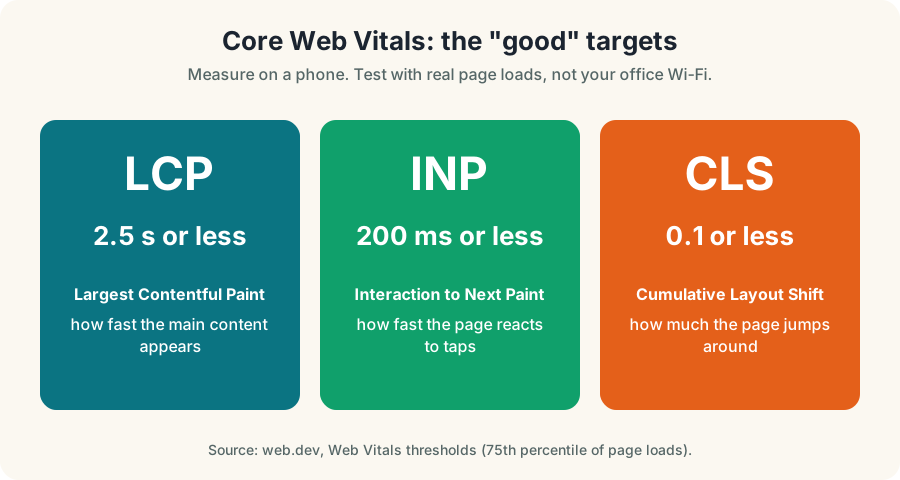
- Speed. Test product pages on a phone against Google's Web Vitals targets: LCP of 2.5 seconds or less, INP of 200 ms or less and CLS of 0.1 or less.
- Clean URLs and no duplicates. Use canonical tags for variants such as color and size.
- Stock status. Mark out-of-stock items clearly instead of deleting the page.
- Mobile checkout. Many shoppers arrive from phones.
What to measure for AEO for ecommerce
Use Search Console for impressions and clicks on product and category pages, your analytics for visits and orders by source, and a monthly list of shopper-style prompts for mentions. Our guide on how to track AEO gives a full routine. For ecommerce, add conversion rate, average order value and return questions to your notes.
A 30-day plan for a small store
- Week 1. Check crawl access, fix speed issues and confirm product data matches everywhere.
- Week 2. Rewrite your top five product pages answer-first, with real facts and photos.
- Week 3. Improve two category pages with buying guidance and a comparison.
- Week 4. Rewrite shipping and returns pages in plain language and start asking for reviews.
Common mistakes
- Copying supplier descriptions. Thousands of stores publish the same text.
- Inconsistent prices. A feed price that differs from the page destroys trust.
- Hiding policies. Shoppers and assistants both look for them.
- Fake urgency and fake reviews. They hurt trust and can create legal trouble.
- No tracking. If you do not measure, you cannot improve.
Next steps
Start with your five best-selling products. Rewrite each page to answer the buying questions, then check the results next month. If you want a partner, see our AEO services guide or our web design services for building a fast, store-ready site.
Ecommerce in Pittsburgh: local pickup and shipping
Pittsburgh shops that sell online have a local advantage if they use it. Say clearly whether you offer local pickup or delivery in Pittsburgh and the surrounding area, give pickup hours and keep them identical on your Google Business Profile. Write "gifts you can pick up in Pittsburgh" style pages only if you really stock and offer them, and list real inventory and real timing.
- Show local options. Pickup, local delivery and shipping times in plain language.
- Use Pittsburgh photos. Real shop, product and pickup photos build trust.
- Collect local reviews. Ask Pittsburgh customers after delivery or pickup.
See our Pittsburgh web design and development service for fast, store-ready sites.
Start AEO for ecommerce with your five best sellers and measure again next month. AEO for ecommerce is not a one-time project: prices, stock and policies change, so your pages must change with them.
Worked examples by industry
The pattern is the same everywhere, but the details change by business. These are illustrative examples of how to apply ecommerce AEO in common local industries. Replace the details with your own real facts.
A roofing or home services company
Customers ask: "How much does a roof replacement cost in Youngstown?", "How long does it take?" and "Do I need a permit?" A strong page opens with a plain answer, explains what changes the price (size, pitch, materials, tear-off layers), shows the steps in order and says what a written estimate includes. It names the service area, shows real project photos and lists the company's license and insurance details only if they are real and current.
A dental or medical practice
Patients ask: "Do you take my insurance?", "What happens at a first visit?" and "Is there an emergency appointment?" Pages should answer plainly, avoid promises about outcomes and be reviewed by the practice for accuracy. Health claims need extra care, so state only what the practice can stand behind.
A restaurant or cafe
Guests ask: "Do you have gluten-free options?", "Is there parking?" and "Can you host 20 people?" Put hours, menu, dietary notes, parking and private-event details in plain text, not only in images or PDFs. Keep them identical on the website and Google Business Profile.
A law, accounting or consulting firm
Clients ask: "What does a consultation cost?" and "What should I bring?" Explain the process, who the service is for and who it is not for. Avoid guarantees. Published expertise should be written by the real person who does the work, with a real bio.
An ecommerce or retail shop
Shoppers ask: "Which size should I choose?" and "Can I return this?" Product pages that answer those questions, with consistent product data, give search engines and assistants something dependable to use.
A step-by-step rewrite you can copy
Take one page and do this in order.
- Write the question the page should answer, in the words a customer would use.
- Write a two-sentence answer and put it at the top.
- Add the details underneath: steps, costs, timelines, requirements.
- Add proof. Real photos, real reviews, real credentials and real examples.
- Add a short FAQ of questions people actually ask, with direct answers.
- Check the facts. Every number, name, hour and price must be true today.
- Add a next step. A call button, a form or a booking link.
Common questions people ask next
Is this just SEO with a new name?
Mostly it builds on the same foundation. Clear, useful, accurate pages on a technically healthy site are what both depend on. The difference is emphasis: AEO focuses on direct answers, clear facts, trust and being easy to quote.
Do I need a special file or markup?
Google says there are no additional requirements or special optimizations for its AI features beyond being indexed and eligible to show with a snippet. Structured data is still worth using where it fits, as long as it matches what visitors can see on the page.
How long until I see results?
There is no fixed timeline. Google says crawling and indexing can take anywhere from several days to several months, and results depend on competition and the quality of your pages. Plan on months, not days, and measure monthly.
Can I pay to be recommended?
No reputable method guarantees a mention in an AI answer, and Google says you cannot pay to improve your local ranking. Be suspicious of anyone who promises guaranteed placement.
Glossary
Terms
- AEO: Answer Engine Optimization, making content easy to use as an answer.
- AI Overview: an AI-generated summary shown in Google results.
- Snippet: the text excerpt shown for a page in results.
- Crawler: software that visits pages to read them.
More terms
- Structured data: code that labels facts on a page for machines.
- Citation: a source an assistant links or names in an answer.
- Prompt: the question a person types or says to an assistant.
- Entity: a clearly identified thing, such as your business.
A 90-day plan
- Days 1 to 30: foundation. Confirm your site is indexed, crawlers are allowed, your Google Business Profile is complete and your facts match everywhere.
- Days 31 to 60: content. Rewrite your five most important pages answer-first and add honest FAQs.
- Days 61 to 90: proof and measurement. Collect real reviews, add case examples you have permission to share and start a monthly prompt-testing sheet.
Honest limits
No one controls what an AI assistant says. Answers change, sources change and platforms change their rules. What you can control is the quality, clarity and accuracy of what you publish, and how easy it is for customers and machines to trust it. That is a good investment even if the technology shifts, because the same pages serve people who find you in any way.
Questions, answered
What is AEO for ecommerce?
It is making product, category and policy pages answer shoppers' questions clearly, with accurate, consistent data, so search engines and AI assistants can trust and recommend your store.
Do I need product schema for AEO?
Structured data can help machines read your pages, but Google says no special markup is required for its AI features. Whatever you use must match visible page text.
How do reviews help ecommerce AEO?
Real reviews are trust signals for shoppers and search engines. Collect them honestly and never write or buy them.
Should I block AI crawlers on my store?
If you want to be found, allow search crawlers. OpenAI says OAI-SearchBot surfaces sites in ChatGPT search, and sites opted out will not be shown in its answers.
What should I do first?
Fix crawl access and product data accuracy, then rewrite your top five product pages answer-first.
Ask Eighty. He answers in plain English, any time.
Want this done for your business?
Book a FREE 20-minute growth call. We will tell you where you stand and what to fix first.
Get my FREE growth plan AI searchAEO Content: What It Looks Like, With Examples
 AI searchAEO Services: What They Include and What to Avoid
 AI searchAI Security for Small Business: Chronoloq Guide