
Home / Blog / What Is AEO? Answer Engine Optimization Explained
AI searchWhat Is AEO? Answer Engine Optimization Explained
What is AEO? It means making your business the clear, trusted answer in Google and AI assistants. Learn how it differs from SEO and where to start.

- AEO stands for answer engine optimization: being the clear, trusted source behind direct answers.
- Google says no special optimization or markup is required to appear in its AI features.
- Pew Research found that about 34% of U.S. adults have used ChatGPT, roughly double the share in 2023.
- Start with your ten most common customer questions, one clear page each, and consistent business facts.
What is AEO? Answer engine optimization, or AEO, is the practice of making your business easy for search engines and AI assistants to understand, trust and quote when someone asks a question. It is what you do so that when a customer asks Google, ChatGPT or another assistant "who is the best plumber near me" or "how much does a website cost", your business is one of the sources the answer is built from.
This guide explains what AEO means in simple words, how it differs from regular SEO, what Google and OpenAI have actually said about it, and what a small business owner can do about it this month. We also cover the confusion around the term, because a lot of what you find online under "AEO" is about something else entirely.
What is AEO in one paragraph
AEO means shaping your website and your online profiles so that the clear, correct answer to a customer's question comes from you. An "answer engine" is any system that responds to a question with a direct answer instead of only a list of links. That includes the AI summaries at the top of Google results, ChatGPT search, voice assistants and similar tools.
The goal is simple to say and takes steady work to do: be the source those answers lean on. That means pages that answer one question well, facts that are consistent everywhere online, and a business that is easy to verify as real.
What does AEO stand for, and why do the search results look so strange?
If you typed "aeo" into Google and got clothing stores, stock tickers and customs programs, you are not alone. The letters AEO stand for several unrelated things. In this guide, and across digital marketing, AEO means answer engine optimization.
AEO in marketing
- Answer engine optimization
- About being the source of a direct answer
- Used by SEO and content teams
AEO somewhere else
- A clothing retailer
- A customs trade program in some countries
- Random stock ticker searches
This is also why we do not chase the bare keyword "AEO" on its own. People searching it are a mixed crowd. The people worth reaching are the ones who add a word that makes the meaning clear, such as "AEO services", "how to optimize for AEO" or "AEO content". Those are the topics this guide and the rest of our AI search series are built around.
AEO vs SEO: what is actually different?
SEO is the work of making your pages easy to find, crawl and rank in search results. AEO is the same foundation, plus extra attention to how clearly your content answers a question and how easy it is for a machine to confirm that answer is right.
Here is the honest version. Google says there are no additional requirements to appear in its AI Overviews or AI Mode, and no special optimizations beyond standard SEO practices. So AEO is not a secret second discipline. It is good SEO with sharper writing and cleaner facts.
Classic SEO asks
- Can search engines crawl and index this page?
- Does it match what people search for?
- Is it fast and usable on a phone?
- Do other sites trust it with links?
AEO adds
- Does the first sentence answer the question?
- Are the facts clear and consistent everywhere?
- Can a machine tell who wrote it and who we are?
- Are we mentioned on trusted sites too?
If someone tells you AEO needs special files, secret markup or a trick, be careful. Google's own guidance says you do not need new machine readable files, AI text files or special structured data to appear in these features.
Why knowing what is AEO matters now
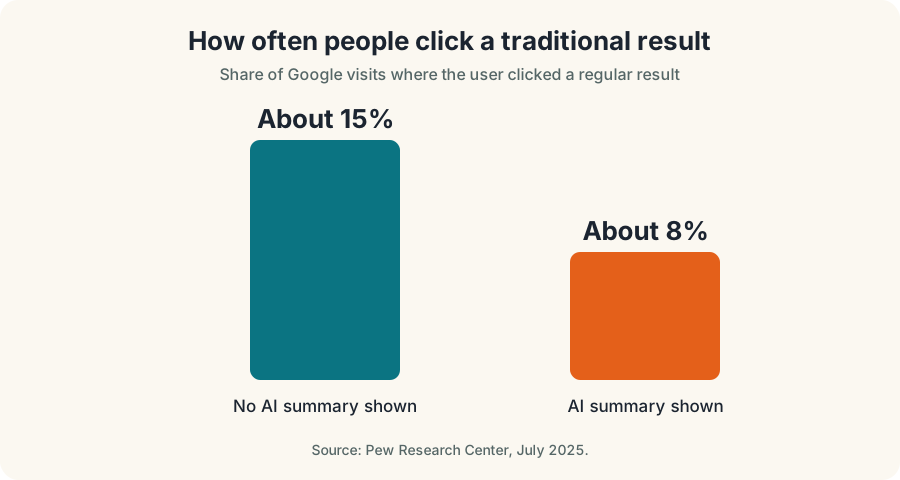
People are changing how they search. Pew Research Center found in 2025 that about 34% of U.S. adults have used ChatGPT, roughly double the share in 2023, and Google often shows an AI answer above its usual results. That does not mean your traffic disappears. It means that being named or linked inside those answers is worth more.
There is a second reason. Customers now ask full questions in plain language. "What should I do if my basement floods in Youngstown" is not a keyword. It is a question, and the best answer wins attention. Writing for questions is the heart of AEO.
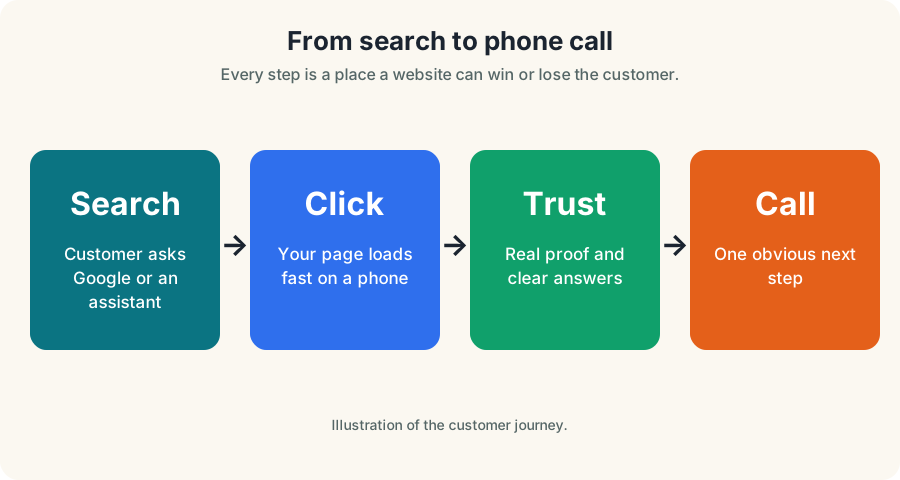
The five building blocks of AEO
- Answer first. Put the direct answer in the first sentence under each heading, then explain.
- One question per page or section. A clear heading that matches the question, followed by a complete answer.
- Consistent facts. Your name, address, phone, hours and services match everywhere.
- Proof you are real. Real reviews, real photos, a real address, named people and named sources.
- Technical access. Search and AI crawlers are allowed in, pages load fast and work on phones.
1. Answer first
AI systems and Google both reward pages that state the answer plainly. Compare these two openings for a page about water heater replacement.
The weak version: "Water heaters are an important part of every home, and there are many things to consider."
The strong version: "Replacing a water heater usually takes a few hours and the cost depends on the size, type and your home's setup. Here is what affects the price and how to choose."
The strong version tells a reader and a machine what the page is about in one sentence. Notice it does not invent a number. If you quote a price, quote your own real range, and say what it depends on.
2. One question at a time
Think about the questions your customers ask before they hire you. How much does it cost? How long does it take? What happens first? Do you serve my town? Give each one its own heading, written the way a customer would say it, followed by a short, complete answer.
This also gives you a natural FAQ section. Keep any structured data honest. Google's guidance says structured data should match the visible text on the page, so only mark up what a visitor can really see.
3. Consistent facts
Answer engines compare what your website says with what other places say. If your phone number is different on your website, your Google Business Profile and a directory, the system has less reason to trust any of them. Pick one correct version of your business name, address, phone number, hours and service list, and use it everywhere. Our guide on showing up on Google Maps in Youngstown covers the local side of this.
4. Proof that you are real
Trust is a pile of small signals: reviews written by real customers, photos of your actual team and work, a physical business address, an About page with real names, and pages that cite named sources. Google says more reviews and positive ratings can improve local ranking, and the same signals help people trust you once they find you.
5. Technical access
If a search or AI crawler cannot reach your page, nothing else matters. Google says a page must be indexed and eligible to appear in Search with a snippet to be shown as a supporting link in AI features. OpenAI says OAI-SearchBot is the crawler that surfaces sites in ChatGPT search, and that sites opted out of it will not be shown in ChatGPT search answers.
What Google and OpenAI actually say
It is worth reading what the platforms themselves say, because there is a lot of guesswork online.
- Google: No additional requirements to appear in AI Overviews or AI Mode, no special optimization needed, and no special schema.org markup required. Standard SEO practices still apply, and AI feature traffic is included in your normal Search Console data.
- OpenAI: OAI-SearchBot is for search and surfaces sites in ChatGPT search. GPTBot relates to content that may be used to train its models, and each setting is independent. A site can allow search while disallowing training.
That tells you something useful. The fastest AEO wins are not tricks. They are making sure the doors are open and the answers are clear.
A realistic example
Imagine a small cleaning company. Before, its homepage says "Premier cleaning solutions for discerning clients" and nothing else. After an AEO pass, the company adds a page called "How much does house cleaning cost in Youngstown?" that opens with a direct answer, explains what changes the price, lists the areas served, shows real before and after photos, and links to its Google Business Profile. Its hours and phone number are identical everywhere.
Nothing in that example is exotic. It is a page that answers a real question, backed by consistent facts. That is the whole idea. Results are never guaranteed, and nobody can promise that a specific assistant will name you.
Common AEO myths
- "You need a special AI file." Google says you do not need new machine readable files or AI text files to appear in its AI features.
- "Keywords do not matter anymore." They do. They tell you which questions to answer. You simply use them in natural sentences, not stuffed lists.
- "AEO replaces SEO." It does not. It builds on it.
- "Someone can guarantee you a spot in ChatGPT." No one can. Be wary of anyone who promises it.
- "More content always wins." Clear and correct beats long and vague.
A simple AEO starter plan for a small business
- Write down your ten most common customer questions. Your phone calls and emails are the best source.
- Give each question a section or page with a direct first sentence.
- Fix your basics. Business name, address, phone, hours and services are identical on your site, your Google Business Profile and your main directories.
- Collect and reply to real reviews.
- Check access. Make sure robots.txt does not block search crawlers, and test your pages on a phone.
- Track what happens. Watch your Search Console data and your calls and forms. Our guide on how to track AEO shows how.
Do you need to hire someone?
You can do a lot yourself. If you want help, read our guide on AEO services and what to expect so you know what a fair offer looks like, and try our FREE AI Visibility Test to see where you stand today.
The bottom line
AEO is not magic and it is not new. It is the habit of answering real questions clearly, keeping your facts consistent and making it easy for people and machines to trust you. Start with ten questions, one clear page each and a clean Google Business Profile, and you are ahead of most of your local competitors.
AEO for Pittsburgh businesses
People in Pittsburgh now ask assistants things like "who is the best roofer in Pittsburgh", "how much does a divorce lawyer cost in Allegheny County" or "where can I get a same-day oil change in Robinson". Whoever has clear, local, accurate pages is easier to name. For a Pittsburgh business that means naming the neighborhoods and suburbs you really serve, such as the Strip District, Lawrenceville, Squirrel Hill, Oakland, the South Side, Mt. Lebanon, Cranberry Township and Monroeville, and keeping your address, hours and phone identical everywhere.
- Say where you work. List the Pittsburgh areas you serve on a real page, not only in a footer.
- Answer Pittsburgh questions. Cost, timing, permits and seasonal issues that are specific to Western Pennsylvania.
- Match your profile. Your Google Business Profile, website and directory listings should agree.
If you want this done for you, see our Pittsburgh AI search optimization service or our Pittsburgh SEO services.
If you only remember one thing about what is AEO, remember this: clear answers on accurate, trusted pages win. So when someone asks what is AEO and whether it replaces SEO, the honest answer is no. It builds on SEO.
Worked examples by industry
The pattern is the same everywhere, but the details change by business. These are illustrative examples of how to apply AEO in common local industries. Replace the details with your own real facts.
A roofing or home services company
Customers ask: "How much does a roof replacement cost in Youngstown?", "How long does it take?" and "Do I need a permit?" A strong page opens with a plain answer, explains what changes the price (size, pitch, materials, tear-off layers), shows the steps in order and says what a written estimate includes. It names the service area, shows real project photos and lists the company's license and insurance details only if they are real and current.
A dental or medical practice
Patients ask: "Do you take my insurance?", "What happens at a first visit?" and "Is there an emergency appointment?" Pages should answer plainly, avoid promises about outcomes and be reviewed by the practice for accuracy. Health claims need extra care, so state only what the practice can stand behind.
A restaurant or cafe
Guests ask: "Do you have gluten-free options?", "Is there parking?" and "Can you host 20 people?" Put hours, menu, dietary notes, parking and private-event details in plain text, not only in images or PDFs. Keep them identical on the website and Google Business Profile.
A law, accounting or consulting firm
Clients ask: "What does a consultation cost?" and "What should I bring?" Explain the process, who the service is for and who it is not for. Avoid guarantees. Published expertise should be written by the real person who does the work, with a real bio.
An ecommerce or retail shop
Shoppers ask: "Which size should I choose?" and "Can I return this?" Product pages that answer those questions, with consistent product data, give search engines and assistants something dependable to use.
A step-by-step rewrite you can copy
Take one page and do this in order.
- Write the question the page should answer, in the words a customer would use.
- Write a two-sentence answer and put it at the top.
- Add the details underneath: steps, costs, timelines, requirements.
- Add proof. Real photos, real reviews, real credentials and real examples.
- Add a short FAQ of questions people actually ask, with direct answers.
- Check the facts. Every number, name, hour and price must be true today.
- Add a next step. A call button, a form or a booking link.
Common questions people ask next
Is this just SEO with a new name?
Mostly it builds on the same foundation. Clear, useful, accurate pages on a technically healthy site are what both depend on. The difference is emphasis: AEO focuses on direct answers, clear facts, trust and being easy to quote.
Do I need a special file or markup?
Google says there are no additional requirements or special optimizations for its AI features beyond being indexed and eligible to show with a snippet. Structured data is still worth using where it fits, as long as it matches what visitors can see on the page.
How long until I see results?
There is no fixed timeline. Google says crawling and indexing can take anywhere from several days to several months, and results depend on competition and the quality of your pages. Plan on months, not days, and measure monthly.
Can I pay to be recommended?
No reputable method guarantees a mention in an AI answer, and Google says you cannot pay to improve your local ranking. Be suspicious of anyone who promises guaranteed placement.
Glossary
Terms
- AEO: Answer Engine Optimization, making content easy to use as an answer.
- AI Overview: an AI-generated summary shown in Google results.
- Snippet: the text excerpt shown for a page in results.
- Crawler: software that visits pages to read them.
More terms
- Structured data: code that labels facts on a page for machines.
- Citation: a source an assistant links or names in an answer.
- Prompt: the question a person types or says to an assistant.
- Entity: a clearly identified thing, such as your business.
A 90-day plan
- Days 1 to 30: foundation. Confirm your site is indexed, crawlers are allowed, your Google Business Profile is complete and your facts match everywhere.
- Days 31 to 60: content. Rewrite your five most important pages answer-first and add honest FAQs.
- Days 61 to 90: proof and measurement. Collect real reviews, add case examples you have permission to share and start a monthly prompt-testing sheet.
Honest limits
No one controls what an AI assistant says. Answers change, sources change and platforms change their rules. What you can control is the quality, clarity and accuracy of what you publish, and how easy it is for customers and machines to trust it. That is a good investment even if the technology shifts, because the same pages serve people who find you in any way.
Questions, answered
What does AEO stand for?
In marketing, AEO stands for answer engine optimization. The same letters also stand for unrelated things, such as a clothing retailer and a customs trade program.
Is AEO the same as SEO?
They overlap a lot. AEO builds on SEO with extra focus on direct answers, consistent facts and trust signals. Google says no special optimization beyond standard SEO is needed for its AI features.
Do I need special schema or an AI file for AEO?
Google says you do not need special schema.org markup or new machine readable files to appear in AI Overviews or AI Mode. Any structured data you use should match the visible text on the page.
Can anyone guarantee that ChatGPT will name my business?
No. Nobody controls what an assistant says. You can make your business easy to find, understand and trust, but results are never guaranteed.
How do I start AEO for a local business?
List your ten most common customer questions, answer each one clearly on your site, keep your business details identical everywhere, collect real reviews and make sure search crawlers can reach your pages.
Ask Eighty. He answers in plain English, any time.
Want this done for your business?
Book a FREE 20-minute growth call. We will tell you where you stand and what to fix first.
Get my FREE growth plan AI searchAEO Content: What It Looks Like, With Examples
 AI searchAEO for Ecommerce: Get Your Products Recommended
 AI searchAEO Services: What They Include and What to Avoid